
DeKalb County Arrest Records and Charges
DeKalb County arrest records are created on the law-enforcement side. They can reflect who was arrested, the booking number, booking date, arresting agency, jail status, housing unit, charge descriptions, statutes, levels, counts, bond, and mugshot data when the person appears in the sheriff roster. The official sheriff inmate search loads current roster data through an API, and some entries may show an empty charges array or bond values that need verification.
Court charge records begin when the prosecutor files charges in court. Indiana uses the term Prosecuting Attorney, and the DeKalb County Prosecutor's Office prosecutes criminal cases for the State of Indiana. Once charges are filed, they become part of the case record kept by the Clerk of Courts. The full court case, pleas, hearings, disposition, and sentence belong in the DeKalb County criminal court records file.
The official sheriff inmate search API source was captured from the DeKalb sheriff site and shows the charge fields used in current custody records.
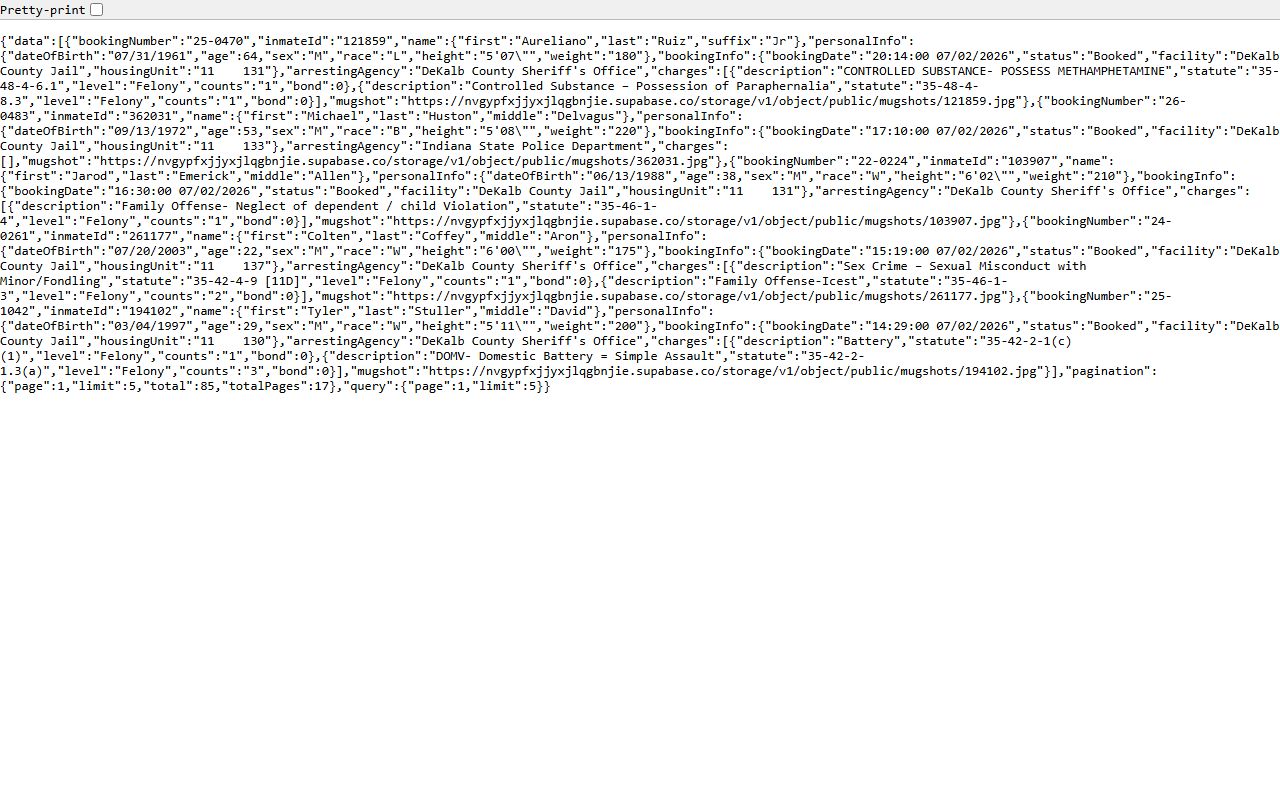
Those booking charge fields are useful, but filed court charges should still be checked in the court case record.
Find DeKalb County Arrest Records
The official custody path starts with the DeKalb County Sheriff's Office inmate search for current jail roster information. That roster is the best county source for recent custody status, booking number, arresting agency, jail facility, housing unit, charge text, statutes, counts, and bond per charge when the data is available. It should not be treated as a complete criminal court record.
- Check the sheriff inmate search for current jail custody and booking information.
- Use the name, booking number, charge text, or arresting agency details to identify the matter.
- Search MyCase by name, case number, citation number, or court once court charges are filed.
- Select DeKalb County for Circuit and Superior Court charges or DeKalb County - Butler City Court when the matter is in city court.
- Compare each filed charge with disposition and sentencing entries before treating the result as a conviction.
- Request official court copies from the Clerk or law-enforcement records from the sheriff records division as needed.
Records not visible online split by record type. Sheriff records questions can go to sheriff@co.dekalb.in.us or 260-925-3365 ext. 4410. Court copies go to the Clerk of Courts. Certified court dispositions do not come from the jail roster.
Booking Charges vs Filed Charges
A booking charge is the charge label tied to the arrest and jail entry. A filed charge is the prosecutor's formal accusation in court. In DeKalb County, the same event can move from arrest to jail booking to prosecutor review to court filing. The label may change at any stage. A booking charge may be corrected, amended, dropped, or replaced by a different filed count.
| Point | Booking Side | Court Charge Side |
|---|---|---|
| Record keeper | Sheriff and jail records. | Clerk of Courts and trial court case file. |
| Main source | Sheriff inmate search and sheriff records request. | MyCase and Clerk copy request. |
| Common fields | Booking number, status, facility, housing, arresting agency, charge, bond. | Case number, court, charge statute, level, counts, events, disposition. |
| Proof of outcome | Not a final court result. | Disposition and sentencing entries show outcome. |
Charges After Arrest Documents
Court charges after arrest are filed through a charging document. The research did not locate a DeKalb-specific public form inventory for complaints, informations, or indictments, so the safest content is procedural: the prosecutor files the charge in court, the Clerk's case record tracks it, and MyCase may display the charge text, statute, offense degree, offense modification, original degree, citation number, offense date, and counts.
| Document | Typical Filing Role | What It Starts |
|---|---|---|
| Complaint | May be used to state the accusation and facts supporting a charge. | The court record for the charge. |
| Information | Prosecutor-filed charging document used for many criminal prosecutions. | The formal criminal case in court. |
| Indictment | Grand-jury accusation when that path is used. | A felony criminal case based on grand-jury action. |
The DeKalb County local rules add one specific filing point: new charges against a defendant with a pending criminal case are filed in the same court as the pending case. That local rule can explain why a new charge appears under the same court as an existing matter.
DeKalb County Charge Status
Charge status changes as a case moves. A charge may begin as pending, then be amended, reduced, dismissed, or resolved by plea or trial. The docket and disposition fields matter because the charge list alone does not prove the outcome. A single arrest can produce several separate counts, and each count can have a different status.
| Status | What It Means in a Court Charge Record |
|---|---|
| Pending | The charge has been filed and remains unresolved. |
| Amended | The filed charge changed by court action or prosecutor filing. |
| Reduced | The charge level or offense was lowered as part of case action. |
| Dismissed | The charge was ended without a conviction on that count. |
| Disposition entered | The court record has an outcome for the charge or case. |
| Sentenced | A conviction count has sentencing terms recorded. |
Bond Per Charge
The sheriff inmate data can show bond per charge, but the research warns that bond shown online may need verification with the jail or court. The sheriff bail and bonds page explains that some charges are held without bail until a court appearance. It also distinguishes cash bail, own-recognizance release, and bond fee concepts. Bond is not the same as a disposition, and it does not prove guilt.
The DeKalb sheriff bail and bonds source is relevant when arrest records and charge records include bond information.

Bond details should be confirmed with the jail or court because online charge records may lag or omit context.
Charges vs Convictions
DeKalb County arrest records and court charge records should not be read as conviction records without checking the final court outcome. An arrest means law enforcement took a person into custody. A charge means the State has made an accusation in court. A conviction means the court record shows guilt through plea, finding, or verdict.
| Point | Charge | Conviction |
|---|---|---|
| Legal meaning | Formal accusation. | Final guilt outcome. |
| Where it appears | Booking data, charge list, and court case fields. | Disposition and sentencing fields. |
| Can change | Yes, it may be amended, reduced, or dismissed. | Can be appealed or later affected by expungement, but it is an outcome. |
| Best verification | MyCase charge section and Clerk copies. | Certified disposition from the Clerk of Courts. |
Prosecutor and Sheriff Records
The DeKalb County Sheriff's Office is led by Sheriff Brady Thomas and handles jail custody, sheriff records, warrant access, and law-enforcement services from 215 E 8th Street in Auburn. The prosecutor handles criminal prosecutions for the State. Those roles meet after an arrest, but their records are not interchangeable. Sheriff records may document arrest, jail, crash, or law-enforcement activity. Court records document filed charges and case outcomes.
Limited criminal history checks at the sheriff are only accepted in person with state-approved identification and only produce criminal convictions in DeKalb County. Juvenile background checks route to DeKalb County Probation. That sheriff service is narrower than a full court case search and should not be treated as a statewide criminal history or a full court file.
The Sheriff Brady Thomas source identifies the local sheriff for DeKalb County arrest records context.
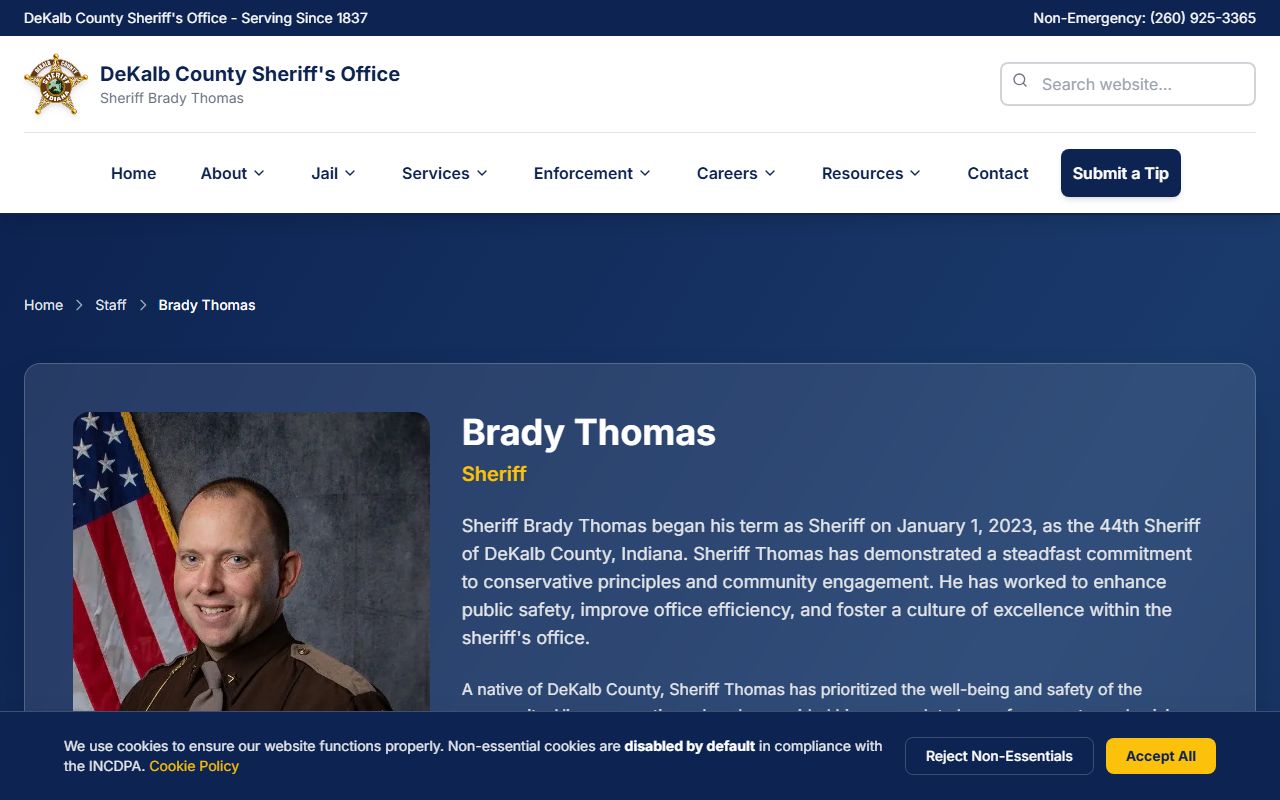
That source supports the local law-enforcement context without replacing the court charge record kept by the Clerk.
Sealed and Expunged Charges
Indiana law allows eligible arrest, charge, and conviction records to be sealed or expunged through a court process. In DeKalb County, XP expungement cases are filed in the court with the underlying criminal case. If multiple criminal cases apply, the case with the highest offense controls, or the most recent highest-level case controls when several cases share the same highest level.
| Point | Sealed | Expunged |
|---|---|---|
| Public access | Restricted from ordinary public view. | Restricted after a court order under Indiana expungement law. |
| May affect | Charge details, documents, or sensitive case data. | Arrest, charge, or conviction visibility depending on eligibility and order. |
| Local filing rule | Depends on the underlying case and court order. | XP filing goes to the underlying criminal case court. |
| Not automatic | Requires a rule, order, or legal basis. | Eligibility depends on outcome, waiting period, offense level, sentence completion, and exclusions. |
Note: Juvenile charges and sealed cases are not searched like ordinary adult arrest or charge records.
Access Limits for Charge Records
Public access to charge records depends on which record is requested. MyCase is the statewide case search for filed court charges. The sheriff inmate search is a current custody and booking tool. The sheriff records division handles law-enforcement public-record requests and reports. The Clerk of Courts handles court file copies and certified documents. Each path has its own rules, fees, and limits.
Indiana Access to Court Records Rule 5 excludes certain court records and data from public access. Indiana Code Title 35 includes expungement provisions. Indiana juvenile law restricts juvenile records. Personal identifiers, financial account numbers, minors' names, confidential medical details, mental-health material, sealed records, and expunged records can be withheld or redacted. A missing online result does not always mean no record ever existed.