
DeKalb County Probate Jurisdiction
DeKalb County does not publish a separate probate court page in the official court structure. Probate-type matters are handled through the DeKalb Circuit and Superior Courts under Indiana trial-court jurisdiction and the local case allocation plan. The county court list includes DeKalb Circuit Court, DeKalb Superior Court, DeKalb Superior Court #2, and Butler City Court. Butler City Court is a lower court and is not the probate venue described in the research.
The local rules give useful detail for probate searches. Superior Court II has exclusive filing for ES cases, and guardianship GU cases rotate between Circuit Court and Superior Court II. Other estate-related codes such as EU also rotate between Circuit Court and Superior Court II. That means a DeKalb County probate search should not assume one courtroom or one judge handles every estate or guardianship file.
Common probate records include estate administration, will admission, personal representative appointment, guardianship of an adult or minor, trust-related filings, creditor claims, inventory or accounting if public, final accounting, and closing orders. Some records are public case information, while medical, financial, minor, and protected-person details may be restricted.
DeKalb County Probate Terms
Probate terms can be confusing because the same case may involve a decedent, an estate, a personal representative, creditors, heirs, protected persons, and attorneys. These definitions are plain-language aids for reading DeKalb County probate records, not a substitute for legal advice.
- Testator
- A person who made a will before death.
- Executor
- A person named in a will to carry out estate duties, often called a personal representative in court records.
- Intestate
- Dying without a valid will, so estate distribution follows Indiana law and court process.
- Guardianship
- A court case appointing someone to manage personal or financial affairs for a minor or protected adult.
- Conservatorship
- A protective court arrangement for financial or property management, often discussed with guardianship concepts.
Search DeKalb County Probate Records
MyCase is the online case search path for DeKalb County probate case information. Choose DeKalb County in the court dropdown and use the Probate category when it is displayed. Search by case number if known, or use names tied to the estate, decedent, protected person, personal representative, attorney, or party. Because MyCase is not the official certified record, official copies and documents not available online must be requested from the Clerk of Courts.
- Open Indiana MyCase and choose DeKalb County in the court dropdown.
- Select the Probate category when that option appears for the court search.
- Search by estate name, decedent name, protected person name, party name, attorney, or case number.
- Review case number, filing date, court, case type, status, parties, attorney entries, events, orders, and public documents.
- Request official copies from the Clerk if a document image is missing, older, restricted, or needed for legal use.
Note: MyCase can help find a probate case, but certified estate and guardianship documents still come from the court maintaining the record.
DeKalb County Probate Contacts
The probate contact path uses the DeKalb Circuit and Superior Courts plus the Clerk of Courts. The Clerk is the copy and records contact for case documents. The court where the case is assigned controls hearings, orders, and filings. All three county trial-court listings use the courthouse address at 100 S Main Street in Auburn, while the Clerk mailing address is P.O. Box 230.
DeKalb Circuit Court
100 S Main Street
Auburn, IN 46706
260-925-2764
Judge Hon. Kurt Grimm
DeKalb Superior Court
100 S Main Street
Auburn, IN 46706
260-925-4723
Judge Hon. Adam C. Squiller
DeKalb Superior Court #2
100 S Main Street
Auburn, IN 46706
260-925-5277
Judge Hon. Patrick Jessup
DeKalb County Clerk of Courts
100 S Main Street
Auburn, IN 46706
260-925-0912
8:00 a.m.-4:00 p.m.
DeKalb County Probate Fees
No DeKalb County probate-specific filing fee schedule was located in the official sources reviewed. The reliable fee schedule for this probate records page is the Clerk copy fee schedule from the court-record copy request form. Filing fees for opening an estate, guardianship, or related probate matter should be verified with the Clerk before filing.
| Item | Amount or Rule |
|---|---|
| Plain copies of court records | $1.00 per page |
| Certification | $3.00 per document |
| Credit/debit card convenience fee | 3% or $1.50 minimum |
| Payment by mail | Money order payable to "DeKalb County Clerk" plus self-addressed stamped envelope. |
| Confidential records | Requester must meet Indiana Administrative Rule 9(B) requirements and present photo ID when picking up documents. |
| Probate filing fees | Not located in official county sources reviewed; verify with the Clerk before filing. |
What DeKalb Probate Records Show
Public DeKalb County probate records may show the case number, filing date, assigned court, case type, case status, estate or guardianship party entries, personal representative or guardian entries, attorney entries, hearings, orders, and available public documents. Estate files may include petitions, wills admitted to probate, orders appointing personal representatives, creditor notices, inventories when not restricted, accountings, and closing orders.
Guardianship records can require more care. A public docket may show that a guardianship case exists, while medical records, financial account numbers, minor identifying information, and protected-person details may be sealed, redacted, or excluded from public access. Indiana Access to Court Records Rule 5 and Rule 9 control many of those limits, and confidential record requests require eligibility rather than ordinary public lookup.
Older DeKalb Probate Files
Older probate files and non-digitized documents may not appear fully in MyCase. If MyCase shows only a docket or no document image, use the Clerk's copy request form and provide the case number, party names, document type, date of filing or order if known, number of copies, and certification choice. The form warns that missing information can delay copies.
Historical Auburn and courthouse-square context can help researchers understand why older county records may be tied to downtown Auburn offices. The National Park Service Downtown Auburn Historic District nomination was listed in the research as local historical context, but it was not used for operational probate instructions because it is not a court-record access source.
Probate vs Bankruptcy Records
Probate and bankruptcy are often confused because both can involve debts, assets, creditors, and court orders. DeKalb County probate matters are Indiana trial-court matters filed through the DeKalb Circuit and Superior Courts. Bankruptcy cases are federal cases and are not filed with the DeKalb County Clerk as probate records. If an estate, heir, creditor, or debtor has a bankruptcy issue, the federal bankruptcy court system is the separate access path.
The U.S. Bankruptcy Court for the Northern District of Indiana is the federal bankruptcy court source assigned in the image manifest for probate context.
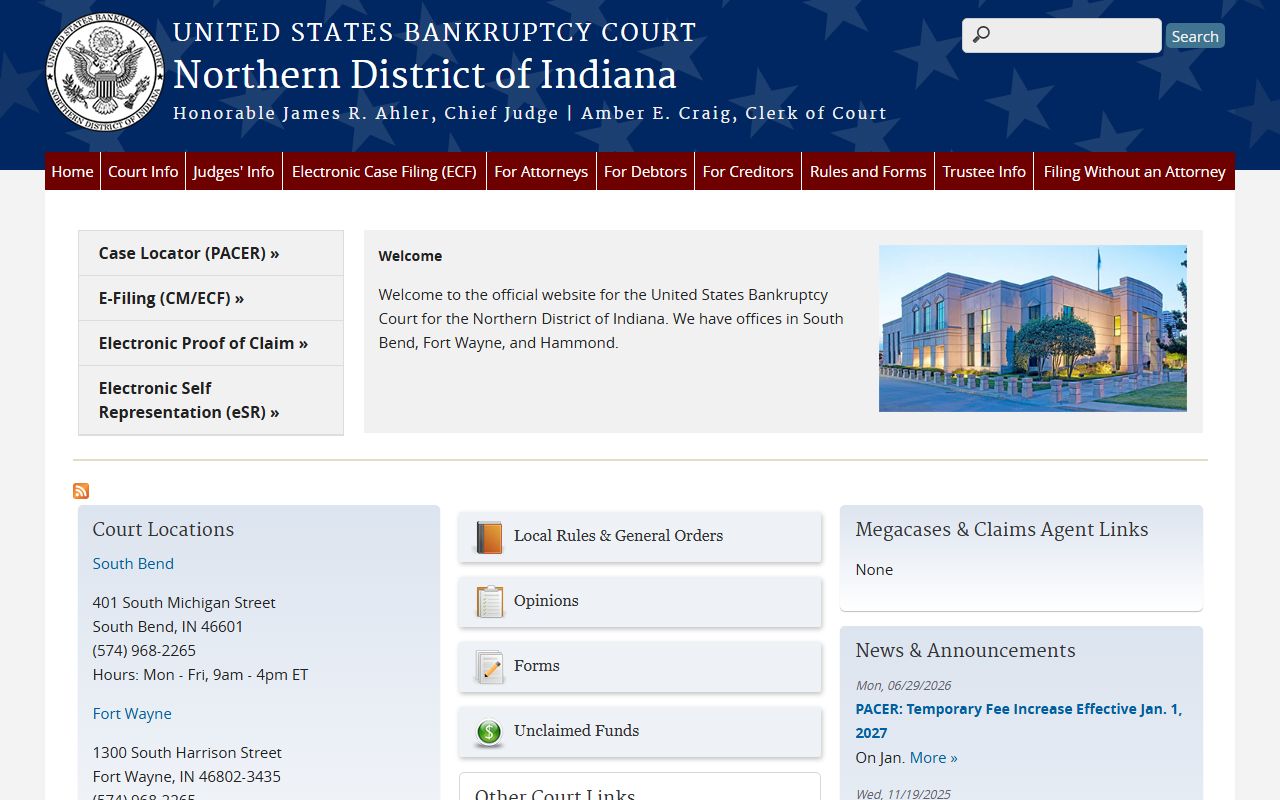
This source helps draw a clean line between county probate records and federal bankruptcy cases.
The federal Northern District bankruptcy CM/ECF system is the electronic filing and case access environment for bankruptcy users, separate from DeKalb County MyCase probate searches.
Using the correct system matters because a county probate case number will not function as a federal bankruptcy CM/ECF search key.
Restricted DeKalb Probate Records
Restricted probate material should not be expected in ordinary search results. Guardianship medical records, protected-person details, minor information, financial account numbers, confidential mental-health information, and sealed filings may be withheld or redacted. Adoption and mental-health case categories also appear in local allocation rules and should be treated as sensitive rather than general public probate files.
The Clerk can provide records and forms but cannot give legal advice. For filing an estate, contesting a will, serving as a personal representative, handling creditor claims, or managing a guardianship, use Indiana self-help resources or counsel. For records access, start with MyCase, then use the Clerk for official copies, certified documents, or older files.